

|
|
|
Family history notes from a grandson of John Martin, written 1899 Elza Martin, born 1831, was the eldest son of John's eldest son Isaac. In his early years, he was acquainted with both of his Martin grandparents, as he was 15 when John died and 32 at the time of Sarah's death. The following letter was sent to his granddaughter Ivy Dorothy Martin (later Dorothy Frost). We are indebted to Dorothy Richardson for preserving the original letter and providing images of it. (I have chosen to show only the first- and last-page images here; others are available on request.) In our pursuit of family history, we could wish that Elza had provided more definite details, such as names, dates, and exact locations. His letter is fascinating nonetheless, for the insight it gives into the character of some of our ancestors. Family history is much more meaningful when we are able to see the subjects of our research as more than just names and dates. 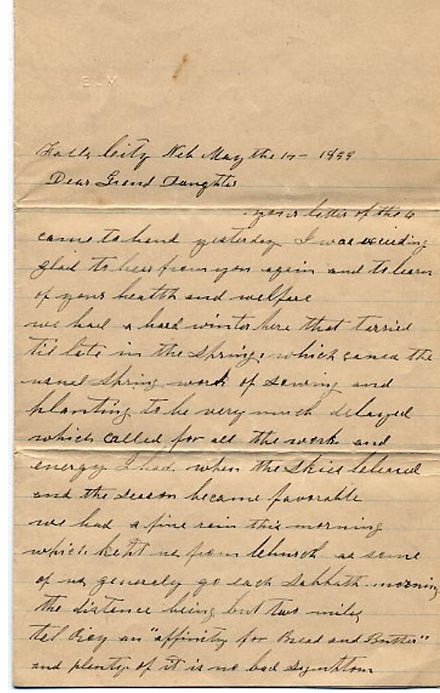
ELM Falls City Neb, May the 14 - 1899 Dear Grand Daughter: Your letter of the 6 came to hand yesterday. I was exceeding glad to hear from you again and to learn of your health and welfare. We had a hard winter here that tarried til late in the Spring, which caused the usual Spring work of sowing and planting to be very much delayed, which called for all the work and energy I had when the skies cleared and the season became favorable. We had a fine rain this morning which kept us from Church as some of us generally go each Sabbath morning, the distance being but two miles. Tell Ray an "affinity for bread and butter" and plenty of it is no bad symptom. I never knew a Martin boy that had not a strong predilection in that direction. I think you are to be congratulated on your penmanship. It is really a beautiful art as well as useful. Am glad to hear the papers went safely to you. Tell your Pa to read the editorials of the Interocean and I'll have no fears of his ever becoming a Copperhead or running wild after Free Trade or Free Silver. You ask if I know anything of the genealogy of the Martin Family. I do not know of any written genealogy except the family records in my Father's old Bible, but I know of much more that has been handed down from father to son for at least five generations of unwritten history but I have received it from my Father and one of his Brothers and also some facts told me by my grandfather Martin when I was not more than 8 years old but of which I have a very distinct recollection til this day. The family emigrated from England before the Revolutionary War but the precise date I do not know, but so long before that when the war broke out they were intensely American, but my first knowledge of any of their personalities dates back to as early as 1774 - 1776 during the Revolutionary struggle when our fathers suffered untold horrors in the Indian wars. My great, great grandfather's name was John Martin, who lived in what is now West Virginia before the Revolutionary War. He was a large, strong man of the frontier type, an athletic bear hunter and Indian fighter of those days, was well known far and near as a stranger to fear and of most untiring energy. During the war the settlers had built a fort, had left their homes and lived in this fort for safety. This family consisted of a man and wife, 2 grown daughters, and a younger son (Edward). The father and daughters went a mile or more from the fort to work on their small farm, as they must raise corn to supply them bread for another year. They were attacked by a band of five Indians. The father started the girls for the fort, grasped his rifle, shot one of the Indians dead. They attacked him with their tomahawks, he clubbed his rifle and killed two more of them. One of the surviving Indians struck and broke his right arm with a tomahawk, when they soon dispatched him as one of his arms was powerless. The two surviving Indians were captured by a small band from the fort. One of them said in broken English that man would have killed both the others if they had not broke his arm. That was the end of my great, great grandfather. His son, Edward, was my great grandfather, a man in most respects very much like his father. My grandfather's name was John Martin. His mother died when he was a youth and now comes in another branch of the family. In those early days a house was burned by the Indians at dead of night. All the family were murdered but one little girl of 4 years old. She left the burning house and escaped in the darkness and was taken care of by friends when the Indians were gone. When she was grown she married a man by the name of Stanley and became the mother of Sally Stanley. Mr. Stanley died and my great grandfather married his widow and brought their two families together. So when John Martin was aged 18 and Sally Stanley 16 (stepbrother and sister), they were married and my father was their firstborn. They called him Isaac. His brothers were Ambrose, Joseph, John, and Archelaus. His sisters were Louisa, Betsy, Lucinda, and Sally. All these are dead but Arch, Sally and Ambrose were living the last I heard of them 2 years ago. 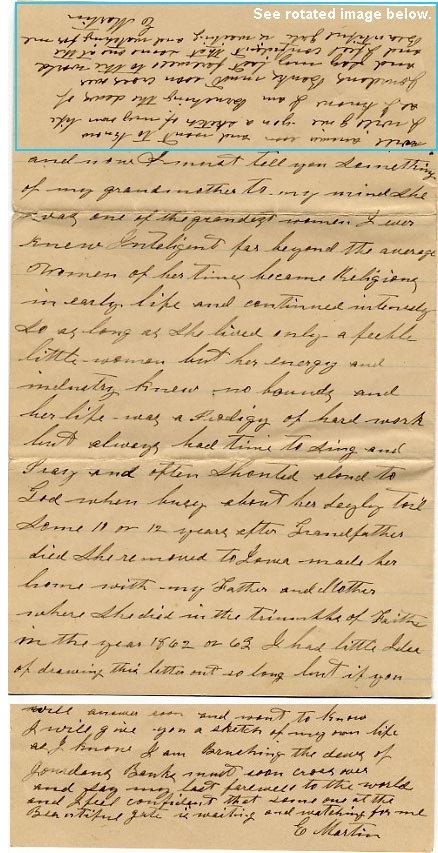
My grandfather, John Martin, was a pioneer hunter and did his part in ridding the new country of bears, wolves, Indians and he was in the War of 1812 under General Harrison and acted, for a while at least, as a recruiting officer for the Army. When peace was restored he settled and raised his family in Athens Co., Ohio. Then about the year 1836 or 37 he removed to Coles Co., Illinois, where he died about the year 1846 or 47. He was intelligent, a good talker when he would talk. Sometimes he took me on his knee and told me his adventures in the wild country with bears, much to my delight. He was not an intensely religious man but was strictly moral, never drank anything intoxicating, used no tobacco nor coffee. I am sure I never saw him wearing a coat nor a pair of boots or shoes, but he wore the moccasin and hunting shirt of the old pioneers. As I remember him, he was 5 feet 10 inches tall and weighed 200 lbs., a man of whom his posterity need never be ashamed. And now I must tell you something of my grandmother. To my mind she was one of the grandest women I ever knew. Intelligent far beyond the average women of her times, became religious in early life and continued intensely so as long as she lived. Only a feeble little woman, but her energy and industry knew no bounds, and her life was a prodigy of hard work, but always had time to sing and pray and often shouted aloud to God when busy about her daily toil. Some 11 or 12 years after Grandfather died, she removed to Iowa, made her home with my father and mother where she died in the triumph of faith in the year 1862 or 63. I had little idea of drawing this letter out so long, but if you will answer soon and want to know, I will give you a sketch of my own life as I know I am brushing the dews of Jordan's Banks, must soon cross over and say my last farewell to the world, and I feel confident that some one at the beautiful gate is waiting and watching for me.
|